
Calf & Achilles Injuries

Recovery Support for Runners, Pickleball Players, and Active People in Delray Beach

Few injuries sideline an active person faster than a calf strain or an Achilles flare-up. One awkward push off the pickleball court, one sprint for a loose ball, one long run too many — and the back of the lower leg seizes, tightens, or gives way. At Acupuncture Zen in Delray Beach, Dr. Tony Willcox treats these injuries the way sports-medicine teams do — as soft-tissue problems that respond to targeted, hands-on care — drawing on the same modalities he has used with UFC fighters, NHL athletes, and weekend warriors alike.

Calf and Achilles injuries share a common trait: they are slow to heal and quick to return if rushed. The lower leg carries enormous load with every step, and the Achilles tendon — the thickest, strongest tendon in the body — has a notoriously limited blood supply, which is part of why these injuries can linger for weeks or months. A thoughtful, integrative approach is built to support that healing rather than force it.

Calf and Achilles injuries are among the sports and active-injury conditions treated at the clinic.
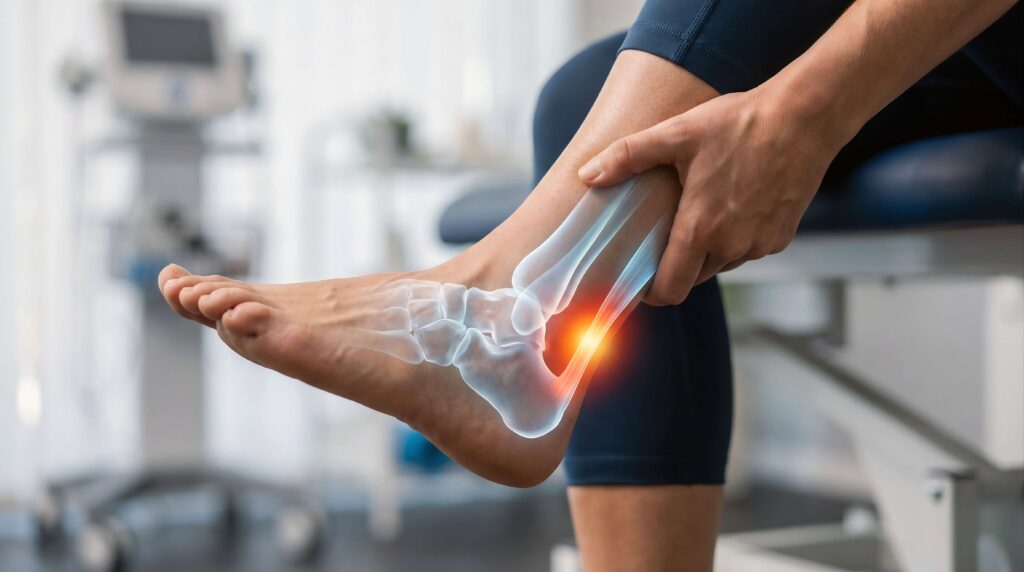
Active person holding their painful Achilles tendon and ankle

What Are Calf and Achilles Injuries?

The “calf” is really two muscles — the gastrocnemius and the soleus — that join into the Achilles tendon, which anchors to the heel bone. Injuries along this chain fall into a few common patterns:

Calf Strain (Muscle Tear)

A calf strain is a tear in the muscle fibers, usually of the gastrocnemius, and is graded by severity:

Grade I — a mild overstretch with minimal fiber damage; tightness and discomfort, but walking is still possible.

Grade II —  a partial tear; noticeable pain, swelling, bruising, and difficulty pushing off or rising onto the toes.

Grade III — a complete muscle tear; significant pain, swelling, and loss of function that warrants prompt medical evaluation.

Calf strains are classic “acceleration” injuries — the kind that strike mid-sprint, on a jump, or on a hard lateral push. Pickleball, tennis, basketball, soccer, and running are all common culprits.

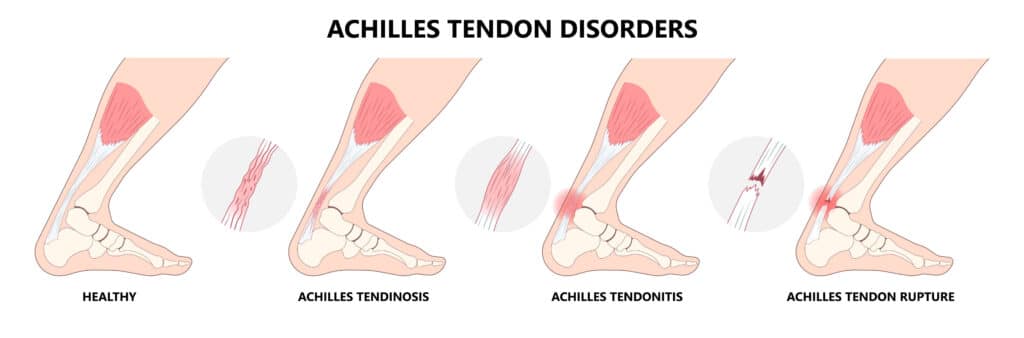
Diagram comparing a healthy Achilles tendon with Achilles tendinosis, tendonitis, and tendon rupture

Achilles Tendinopathy (Tendinitis)

Achilles tendinopathy is an overuse injury — a breakdown in the tendon from repetitive load, often building gradually rather than striking all at once. It presents as stiffness and pain along the tendon or at the heel, worse first thing in the morning or at the start of activity. Runners, in particular, know it well, but it affects anyone who ramps up activity faster than the tendon can adapt.

A Note on Achilles Rupture — When to Seek Immediate Care

A complete Achilles rupture is distinct from the injuries above and is a medical emergency. It often announces itself with a sudden pop or a sensation of being kicked in the back of the leg, followed by difficulty walking or pushing off the foot. A suspected rupture needs prompt evaluation by a physician or orthopedic surgeon — it is not something acupuncture or soft-tissue therapy treats, and delaying care can affect the outcome. Once a rupture has been properly diagnosed and medically managed, supportive care can play a role in the rehabilitation phase alongside your medical team.

Common Symptoms & Causes

Calf and Achilles injuries tend to share a recognizable set of signs:

  • Sharp or aching pain in the back of the lower leg or heel
  • Tightness, stiffness, or a “knotted” feeling in the calf
  • Swelling, bruising, or tenderness along the muscle or tendon
  • Pain that worsens with pushing off, climbing stairs, or rising onto the toes
  • Morning stiffness that eases as the tendon warms up (typical of tendinopathy)

Common causes and risk factors include sudden acceleration or changes in direction, a rapid increase in training volume, inadequate warm-up, tight or fatigued calf muscles, worn footwear, and simply the cumulative wear of an active life. Age plays a role too — tendon tissue becomes less forgiving over time, which is why these injuries are so common among active adults returning to sport.

The Chinese Medicine Perspective

In Traditional Chinese Medicine, the lower leg is understood in terms of the flow of Qi and Blood along the channels that run through it — and injury is seen as a disruption of that flow. Trauma, overuse, and strain create what TCM calls stagnation: a local congestion of Qi and Blood that the body reads as pain, stiffness, and restricted movement. The aim of treatment is to move that stagnation, encourage circulation to tissue that heals slowly on its own, and support the body’s return toward normal function. It is a framework that maps remarkably well onto the modern understanding of soft-tissue injury, where restoring blood flow and releasing tight, guarded muscle are central to recovery.

How Acupuncture Zen May Help

At Acupuncture Zen, calf and Achilles injuries are approached with an integrative sports-medicine mindset — rarely a single technique, but a combination tailored to your specific injury and stage of healing. Dr. Tony draws on several complementary modalities:

Dry needling targets the tight, hypersensitive trigger points and muscle guarding that develop around a calf strain — releasing tension and supporting a return toward normal movement. It is one of the most direct tools for the knotted, restricted feeling that follows a muscle injury.
Laser therapy — Dr. Tony’s Class IV K-Laser and THOR Giant Laser Cluster deliver photobiomodulation deep into muscle and tendon. A 2021 systematic review and meta-analysis of 17 trials found that photobiomodulation may help reduce pain and improve function in tendinopathy — particularly when combined with exercise — though the authors note that higher-quality studies are still needed. Dr. Tony uses it as one part of a broader recovery plan, not a stand-alone cure.
Acupuncture supports circulation, helps calm the pain response, and addresses the whole-body patterns — tension, compensation, restricted movement — that surround a lower-leg injury.
Cupping therapy uses decompression to lift and release tight fascia and muscle through the calf, complementing the other techniques.

These are typically combined into a single personalized session — dry needling and laser to the injured tissue, for example, alongside acupuncture for broader support — and adjusted as the injury moves from the acute phase toward full recovery.

What to Expect at Your Visit

Your first visit begins with an assessment of the injury — where it hurts, how it happened, what makes it worse, and how it is affecting your activity. Dr. Tony builds a plan around the specific injury and its stage, then delivers the combination of modalities best suited to it. Sessions are drug-free and non-invasive, and many active patients treat them as part of their return-to-sport routine rather than a one-time fix. Acute strains and recent flare-ups often respond within a few sessions; longer-standing tendinopathy usually benefits from a longer course, since tendon tissue rebuilds gradually. Dr. Tony will give you a realistic sense of the timeline based on your evaluation and your body’s response.

Frequently asked questions

Acupuncture and related modalities are used to support recovery from calf strains and Achilles tendinopathy — helping ease pain, release muscle tension, and promote circulation to tissues that heal slowly on their own. At Acupuncture Zen, this care is used as a complement to appropriate medical evaluation, not a replacement for it, and is tailored to the specific injury and its stage.


Once you have ruled out a serious injury such as a complete rupture (see below), earlier is generally better — supporting circulation and releasing guarded muscle in the earlier phases can help the recovery process. For any severe, sudden, or worsening injury, seek medical evaluation first, then bring supportive care in alongside your medical team.

A complete Achilles rupture is a medical emergency and typically feels different from a strain — often a sudden pop or a sensation of being struck in the back of the leg, with difficulty walking or pushing off the foot. If you suspect a rupture, seek prompt evaluation from a physician or orthopedic surgeon. A strain or tendinopathy, by contrast, tends to involve tightness, aching, and stiffness that still allows movement. When in doubt, get it properly diagnosed first.

That depends on the injury and its stage — which is exactly what Dr. Tony assesses at your first visit. A fresh calf strain may call for dry needling and laser to the injured muscle; a lingering Achilles tendinopathy may lean more on laser and circulation support. Most plans combine several modalities in a single session, with adjustments as you heal.

It varies with the injury. Acute strains and recent flare-ups often respond within a few sessions, while long-standing Achilles tendinopathy usually benefits from a longer course, since tendon tissue rebuilds slowly. Dr. Tony will map out a realistic plan after your evaluation.

Visit our Fee Schedule for current pricing, or call 561-633-3537 — we’re happy to answer any questions before you book.

A Complementary Approach

At Acupuncture Zen, care for calf and Achilles injuries is offered as part of a comprehensive, integrative plan — a complement to the guidance of your physician, physical therapist, or sports-medicine provider, never a replacement for appropriate medical care. For any severe, sudden, or worsening injury, seek medical evaluation first.

Ready to ease a calf or Achilles injury and support your return to activity? Call Acupuncture Zen at 561-633-3537 to schedule a visit in Delray Beach.

Peace and Blessings,
Dr. Tony Willcox, PhD, D.A.O.M.A.P.

Acupuncture Zen logo