


Pickleball is the fastest-growing sport in the country. Running participation keeps climbing, rec soccer leagues are full, and more adults than ever are chasing a loose ball or logging weekend miles. With that surge in activity has come a surge in one very particular kind of injury — the calf strain and the Achilles flare-up. Ask any sports-medicine practitioner what’s filling the schedule, and the back of the lower leg sits near the top of the list.
For many active people, acupuncture for calf and Achilles injuries has become a valued part of getting back on the court or the trail. At Acupuncture Zen in Delray Beach, Dr. Tony Willcox, A.P., approaches these injuries the way sports-medicine teams do — as soft-tissue problems that respond to targeted, hands-on care, drawing on the same modalities he has used with professional fighters and NHL athletes. This guide covers why active adults are so prone to these injuries, how acupuncture and dry needling may support recovery, what a realistic timeline looks like, and how to lower the odds of the next one.
Why Active Adults Are So Prone to Calf and Achilles Injuries
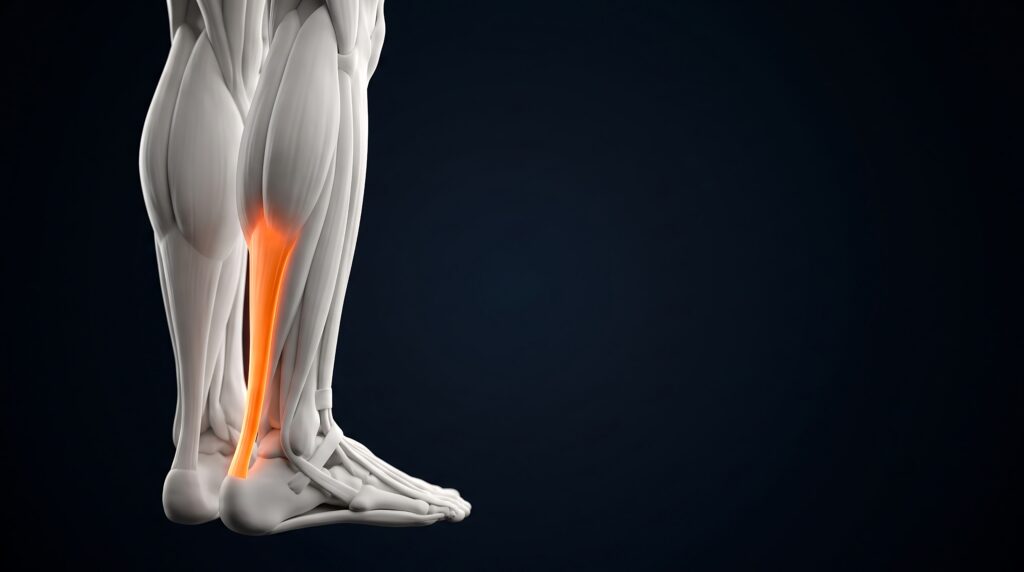
The lower leg is built for explosive movement — and that is exactly what leaves it exposed. Every sprint, jump, and hard lateral push loads the calf muscles and the Achilles tendon with far more force than walking ever does. A few factors stack the odds against active adults in particular.
The “weekend warrior” pattern is a common thread. Many people sit through the work week, then ask their body for a two-hour pickleball session or a long Saturday run. Muscles and tendons that haven’t been progressively loaded adapt poorly to a sudden spike in demand — and the calf is often first to complain.
Age plays a quieter role. Tendon tissue grows stiffer and less forgiving over time, which is part of why Achilles problems climb sharply from the forties onward. And the Achilles itself has a notoriously limited blood supply through its mid-portion — the very reason these injuries can linger for weeks or months rather than clearing in days. When circulation to healing tissue is naturally low, anything that supports blood flow to the area becomes especially valuable.
The Costly Mistake: Playing Through It
The single most common error active people make with a calf or Achilles injury is trying to push through it. A minor tightness gets ignored, the activity continues, and a small, quick-to-heal strain becomes a stubborn, weeks-long problem. Achilles tendinopathy in particular tends to reward early attention and punish neglect — the longer a cranky tendon is loaded without care, the more entrenched the pain and stiffness can become.
Early, supportive care matters. Addressing the tightness, muscle guarding, and restricted movement in the earlier phases — rather than after months of limping through games — tends to make the whole recovery smoother. That is where a modality like acupuncture fits naturally into an active person’s routine.
How Acupuncture and Dry Needling May Support Recovery
Acupuncture and its close cousin, dry needling, work through the same basic tool — a fine, sterile needle — but they are worth understanding at the tissue level, because that is where the value shows up for a lower-leg injury.
Dry needling targets the tight, hypersensitive trigger points and muscle guarding that develop in and around an injured calf. When the gastrocnemius seizes and knots after a strain, those bands of tension restrict movement and feed the pain cycle. Needling those points is associated with releasing that tension and supporting a return toward normal movement — which is why Dr. Tony uses it as one part of a broader recovery plan, never a stand-alone fix.
Acupuncture, meanwhile, supports circulation and helps calm the body’s pain response — useful for a tissue like the Achilles that heals slowly precisely because its blood supply is limited. In Traditional Chinese Medicine, injury is understood as stagnation — a local congestion of Qi and Blood that the body registers as pain and stiffness — and treatment aims to move that stagnation and restore healthy flow. It is a framework that maps closely onto the modern goal of getting blood and movement back into guarded, slow-healing tissue.
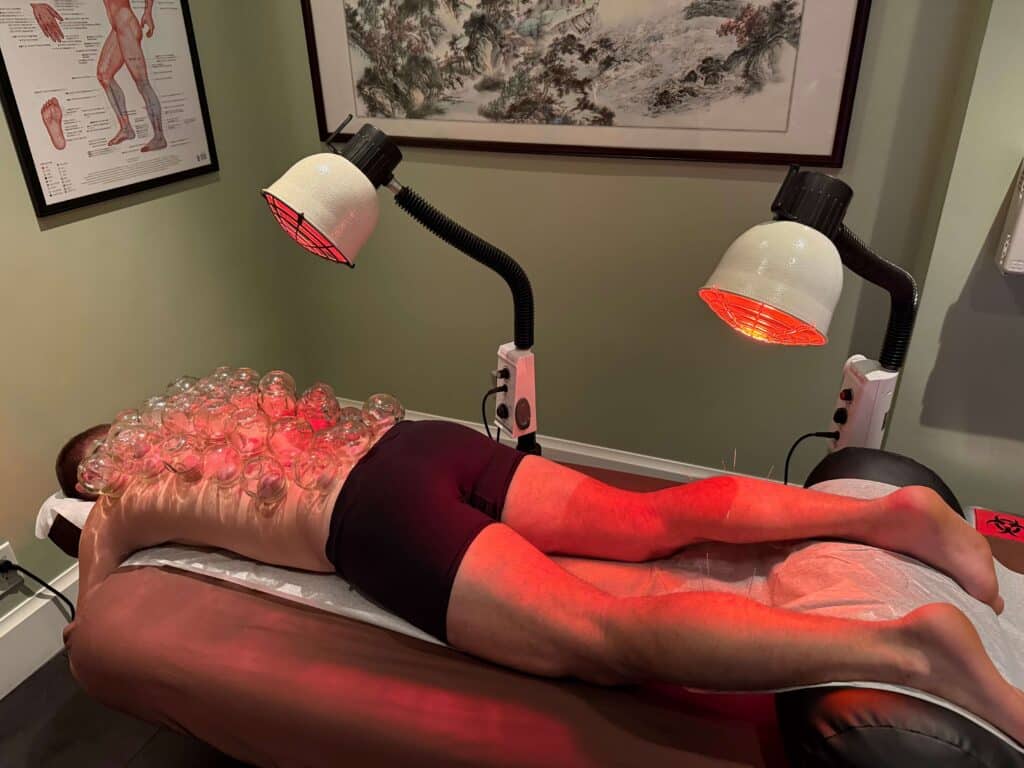
In practice, Dr. Tony rarely relies on a single technique. A calf or Achilles injury might be treated with dry needling to the muscle, acupuncture for broader circulation and pain support, and often laser therapy or cupping alongside. A 2021 systematic review and meta-analysis found that photobiomodulation — the light-based therapy delivered by a therapeutic laser — may help reduce pain and improve function in tendinopathy, particularly when combined with exercise, though the authors note higher-quality studies are still needed. It is one reason Dr. Tony favors a combined, personalized approach, adjusted as the injury moves from the acute phase toward recovery. You can read the full clinical picture on the clinic’s Calf & Achilles Injuries page, and more about the foundation of this care on the acupuncture page.
What Recovery Actually Looks Like
One of the most useful things an active person can have is a realistic sense of the timeline — because calf strains and Achilles tendinopathy heal on very different clocks.
A fresh calf strain — the acceleration injury that strikes mid-sprint or on a hard push — often responds within a handful of sessions once it is given proper attention. Muscle tissue has a good blood supply and tends to heal comparatively quickly, provided it isn’t repeatedly re-injured by rushing back too soon.
Achilles tendinopathy is the most common patient problem. Because tendon rebuilds gradually and their blood supply is limited, a lingering Achilles usually benefits from a longer course of care. Progress here tends to build in layers rather than arrive all at once — which is why a short series of sessions, paired with sensible loading, generally serves the tendon better than a single visit. Dr. Tony maps out a realistic plan after evaluating the specific injury and how the body responds.
Preventing the Next One
The best time to think about a calf or Achilles injury is before it happens. A few general principles help active adults stay in the game:
- Ramp up gradually. Most of these injuries trace back to a sudden spike in activity — a new sport, a jump in mileage, a return after time off. Increasing load steadily gives muscle and tendon time to adapt.
- Warm up with intent. A few minutes of easy movement before hard acceleration prepares the calf and Achilles for the demand that is coming, rather than asking cold tissue to sprint.
- Build calf capacity. Strong, resilient calves tolerate load better. Many active people benefit from regular calf-strengthening work as a long-term habit — a conversation worth having with your practitioner or a qualified trainer, tailored to your history.
- Respect the early warning signs. That first hint of morning Achilles stiffness or mid-game calf tightness is the moment to ease off and address it — not the moment to push harder.
When to See a Doctor First
Not every lower-leg injury is a candidate for supportive care. A complete Achilles rupture is a medical emergency — it often announces itself with a sudden pop or a sensation of being kicked in the back of the leg, followed by difficulty walking or pushing off the foot. A suspected rupture needs prompt evaluation from a physician or orthopedic surgeon, and it is not something acupuncture treats. For any severe, sudden, or worsening injury, get a proper diagnosis first — then supportive care can play its role in the rehabilitation phase, alongside your medical team.
Getting Back in the Game in Delray Beach
Calf and Achilles injuries are frustrating precisely because they sideline you from the activities that keep you healthy and happy. As part of a comprehensive, integrative plan — and a complement to appropriate medical care — acupuncture and dry needling offer active people a drug-free way to support recovery and get back to the court, the trail, or the field.
Ready to ease a calf or Achilles injury and support your return to activity? Call Acupuncture Zen at 561-633-3537 to schedule a visit in Delray Beach.
Peace and Blessings,
Dr. Tony Willcox, PhD, D.A.O.M.
