


Acupuncture for thoracic outlet syndrome is one of the questions Dr. Tony Willcox, A.P., hears most often from patients with stubborn neck, shoulder, and arm symptoms. Thoracic outlet syndrome — often shortened to TOS — can be confusing, slow to diagnose, and frustrating to live with. The good news is that a careful, complementary approach may help calm the tension that feeds it. Here’s how the condition works, and where acupuncture and laser therapy may fit in.
What Is Thoracic Outlet Syndrome?
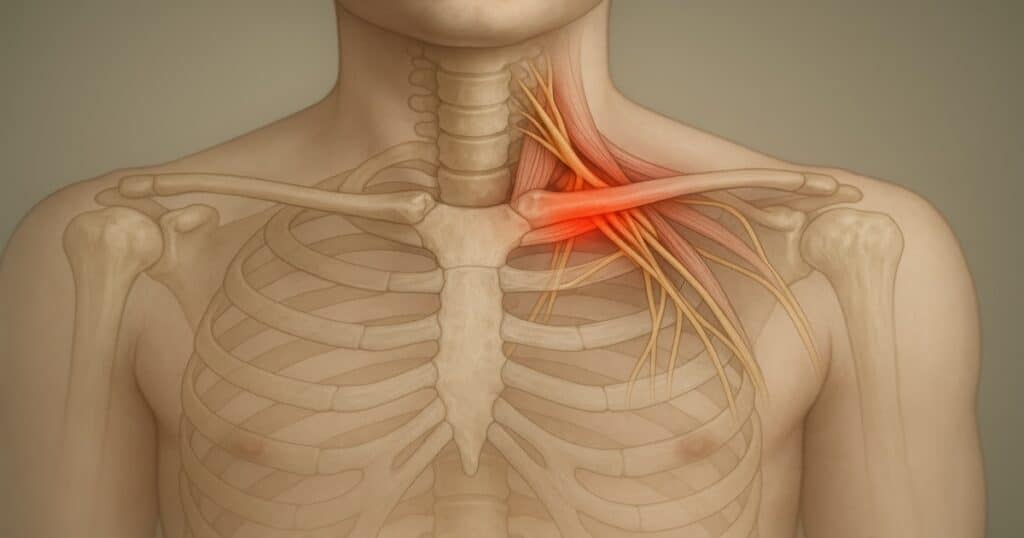
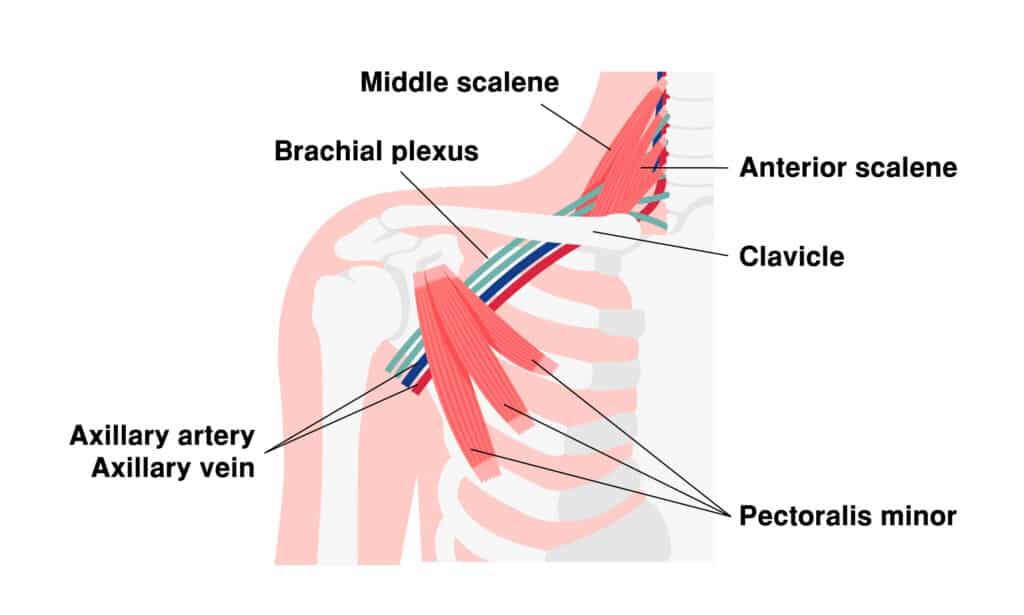
The thoracic outlet is the narrow space between your collarbone and your first rib, bordered by the scalene muscles of the neck. Nerves and blood vessels pass through it on their way to the arm. When that space becomes crowded, those structures get compressed — and that compression is what doctors call thoracic outlet syndrome.
There are three main types. Neurogenic TOS, which involves the nerves, is by far the most common. Venous and arterial TOS involve the blood vessels and are less common — but they matter, as we’ll cover below.
Who Gets Thoracic Outlet Syndrome — and Why

TOS often shows up in people whose daily lives put a load on the neck and shoulders. Because of that, it’s common in athletes, musicians, hairstylists, and anyone who works overhead or at a keyboard for long hours. Medical sources note it appears more often in women and in people with forward-head posture or weaker postural muscles.
The causes usually come down to crowding in that small space. Repetitive overhead motion, an old whiplash injury, pregnancy, or an extra “cervical rib” present from birth can all narrow the outlet. As a result, the nerves and vessels have less room, and symptoms — tingling, aching, weakness, a heavy arm — begin to appear.
See a Doctor First — Especially for Vascular Symptoms
This part is important. While most TOS is neurogenic, the vascular forms can be serious. Sudden arm swelling, a bluish color, coldness, or a suspected blood clot needs prompt medical evaluation — not bodywork. Therefore, acupuncture is always offered as complementary care, alongside proper medical diagnosis, never as a replacement for it. Dr. Tony works best once your physician has ruled out the urgent causes.
How Acupuncture for Thoracic Outlet Syndrome May Help
Once the serious causes are ruled out, much of neurogenic TOS can be traced to tight, irritated muscles — especially the scalenes and the pectoralis minor — that press on the nerve pathway. This is where acupuncture for thoracic outlet syndrome may offer real value.
Fine needles placed into those tight muscles may help them release, easing the crowding around the nerves. In addition, acupuncture may support local circulation and calm an over-sensitized nervous system. The goal isn’t to force anything — it’s to give the outlet a little more room and let irritated tissue settle.
Acupuncture Points and Treatment Strategy
Every case is different, so a practitioner individualizes the plan. Still, acupuncture for thoracic outlet syndrome often works along the nerve’s path from neck to hand.
Points a practitioner may consider include the scalene and pectoralis minor trigger points, along with classical points such as LI4 and LI11 on the arm, LU1 and LU2 near the chest, SI11 and SI12 around the shoulder blade, GB21 on the upper trapezius, and the Huatuojiaji points beside the C5–T1 vertebrae. Local points near the collarbone and along the forearm may round out the pattern.
The strategy is layered: release the tight muscles first, open the nerve pathway, then support circulation and calm the nerve. Because posture drives so much of TOS, the aim isn’t a single dramatic fix — it’s steady, repeated sessions that give irritated tissue the chance to settle and stay settled.
Dosage: What a Course of Care May Look Like
Patients often ask how many sessions they’ll need. A course of acupuncture for thoracic outlet syndrome varies, but a typical plan may involve one to two sessions per week for several weeks, with needles retained for roughly twenty to thirty minutes each visit. Progress is reviewed along the way, and the plan is adjusted as symptoms change. Chronic, long-standing TOS usually asks for more patience than a recent flare.
Does K-Laser Help Thoracic Outlet Syndrome?
Often, yes — as a complement. At Acupuncture Zen, Dr. Tony frequently pairs needling with K-Laser therapy, a Class IV therapeutic laser. Its near-infrared light reaches deep tissue, where it may support circulation, ease inflammation, and calm irritated nerves along the brachial plexus. Research on photobiomodulation for musculoskeletal and nerve-related pain continues to grow, and early findings are encouraging.
For broader, gentler coverage, a red-light cluster such as the THOR system can be used over the neck and chest as well. Both tools share the same aim: to help tissue recover so the nerves have room to settle. Used alongside acupuncture for thoracic outlet syndrome, laser may help the whole plan move along faster.
Bringing It Together at Acupuncture Zen
TOS rarely resolves with a single fix. Instead, it tends to respond to a patient-specific, layered plan — releasing tight muscles, opening the outlet, and supporting the nerves, all alongside your physician’s care. That integrative approach is exactly what Dr. Tony has refined over twenty years, from everyday patients to elite athletes with the Florida Panthers and UFC fight teams.
If you’re weighing acupuncture for thoracic outlet syndrome, the clinic can help you find the right combination for your body. To explore what may work best for you, book a consultation at Acupuncture Zen in Delray Beach.
Peace and Blessings,
Dr. Tony Willcox, PhD, D.A.O.M., A.P.
