Tennis Elbow & Outer Elbow Pain Relief in Delray Beach
Medically reviewed by Dr. Tony Willcox, PhD, D.A.O.M., A.P.
Last reviewed: September 2026



Medically reviewed by Dr. Tony Willcox, PhD, D.A.O.M., A.P.
Last reviewed: September 2026
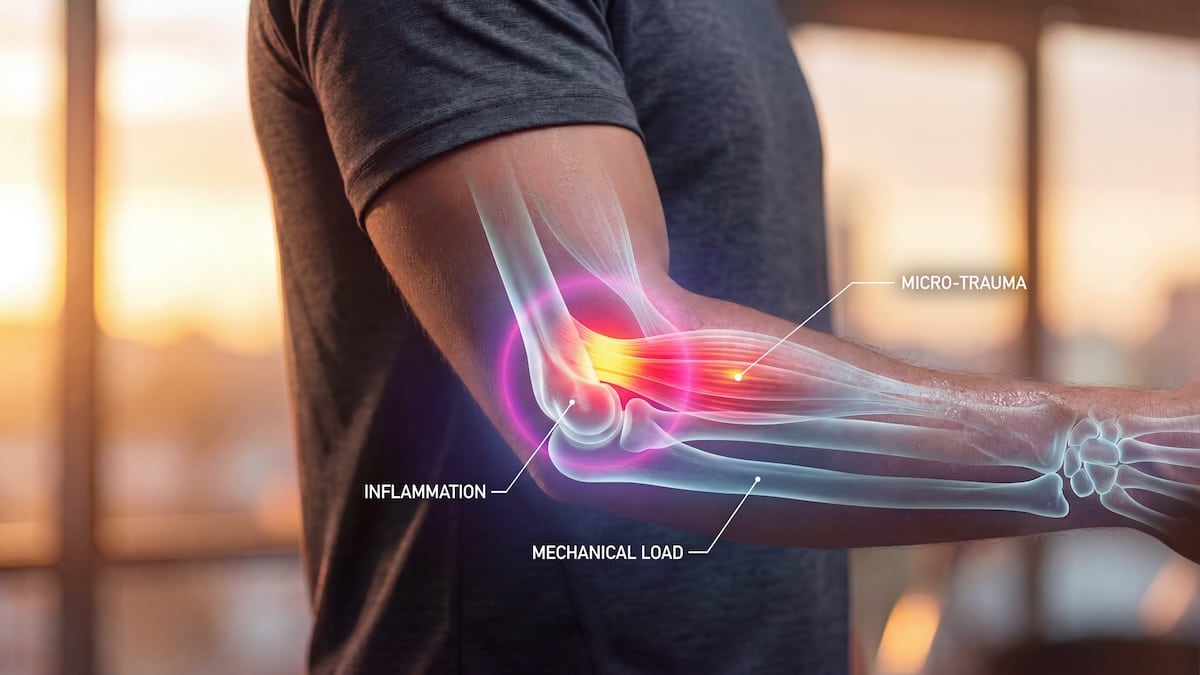
Tennis elbow, known medically as lateral epicondylitis, Its counterpart on the inner elbow is golfer’s elbow (medial epicondylitis) is an overuse injury of the tendons that attach the forearm muscles to the bony bump on the outside of the elbow. Repetitive gripping, lifting, and wrist extension gradually strain and irritate these tendons, leading to pain and tenderness at the outer elbow that can radiate down the forearm. Despite the ‘itis’ in its name, it’s now understood to be more a degenerative wear of the tendon than simple inflammation — which is part of why it can be stubborn and slow to resolve.
Tennis elbow typically involves:
The cause is repetitive strain of the wrist-extensor tendons — from racquet sports, but just as often from manual work, typing, or any repeated gripping. Most cases improve with conservative care over time, though symptoms can persist. Because elbow pain can occasionally have other causes, a medical evaluation is generally considered worthwhile for pain that is severe, follows an injury, or doesn’t improve with conservative care.
In Chinese medicine, tennis elbow is understood as Qi and Blood stagnation in the channels that cross the elbow — particularly the Large Intestine channel, which runs directly over the painful outer elbow area. Repetitive strain blocks local blood flow, and the resulting stagnation manifests as pain, tenderness, and stiffness. Treatment follows the free-flow principle: moving stagnation, releasing the tight forearm muscles, and restoring circulation to the strained tendon so the area can recover.
For tennis elbow, acupuncture is used to ease pain, release the tight wrist-extensor muscles of the forearm, and support circulation to the irritated tendon. Local points around the elbow and forearm are typically combined with distal points, and treatment pairs naturally with eccentric strengthening and load management, which are cornerstones of tendon recovery.
For the tight forearm muscles and trigger points that build up with tennis elbow, dry needling is often used to release those areas, and for this kind of tendon injury, light-based therapies like K-Laser and NovoTHOR red-light therapy are also used to support recovery.
A 2020 systematic review and meta-analysis of ten randomized controlled trials found that acupuncture improved outcomes and reduced pain for tennis elbow compared with sham, medication, and other control treatments (Zhou et al., Pain Research and Management, 2020). The authors were candid that the quality of the available trials was low and larger, rigorous studies are still needed. So acupuncture is offered as a supportive, complementary option for tennis elbow pain — not a guaranteed fix — as part of a patient’s broader care.
A first visit begins with a conversation about how the pain developed, which movements aggravate it, how it affects grip and daily activities, and what care has already been provided. Dr. Willcox will assess the elbow, forearm, and grip before selecting a point protocol, which may combine local points around the elbow with dry needling of the forearm muscles and light-based recovery therapies. Because tendon issues take time to settle, relief usually builds over a series of sessions, and treatment works best paired with the strengthening and activity modification that rehab provides.