


Tennis elbow acupuncture points fall into two groups — local points around the outer elbow, and distal points along the arm and leg. Together, they form the core of how acupuncture may help ease this stubborn tendon pain. Tennis elbow is also called lateral epicondylitis. Despite the name, most people who develop it have never played tennis. Hours on a computer mouse, a hammer, or a golf club can overload the same tendon.
What Is Tennis Elbow?
Tennis elbow affects the tendon that anchors the wrist extensor muscles to the outer elbow. That bony point is called the lateral epicondyle. Repeated gripping and wrist extension strain the tendon over time. As a result, small areas of tendon damage build faster than the body can repair them.
The main symptom is pain on the outside of the elbow. It often spreads into the forearm. Gripping a coffee cup, turning a doorknob, or shaking hands can trigger a sharp twinge. In many cases, the condition lingers for months. For that reason, many patients look for care beyond rest, braces, and pain relievers.
How Acupuncture May Help Tennis Elbow
In Chinese medicine, tennis elbow is seen as a local blockage of Qi and Blood in the channels that cross the elbow. The Large Intestine and San Jiao channels are the main ones involved. Practitioners also consider overuse, cold, and damp as contributing factors.
From a modern view, acupuncture is understood to influence how the nervous system processes pain. It may also improve local circulation and relax tight forearm muscles. Both effects matter for a tendon that heals slowly.
Research on acupuncture for this condition is encouraging but limited. For example, a 2020 systematic review and meta-analysis pooled 10 randomized trials with 796 patients. Acupuncture compared favorably with medication and injection therapy for pain relief and overall response. However, the difference against sham acupuncture was not statistically significant. The authors rated the evidence as low to moderate quality and called for larger, well-designed trials.
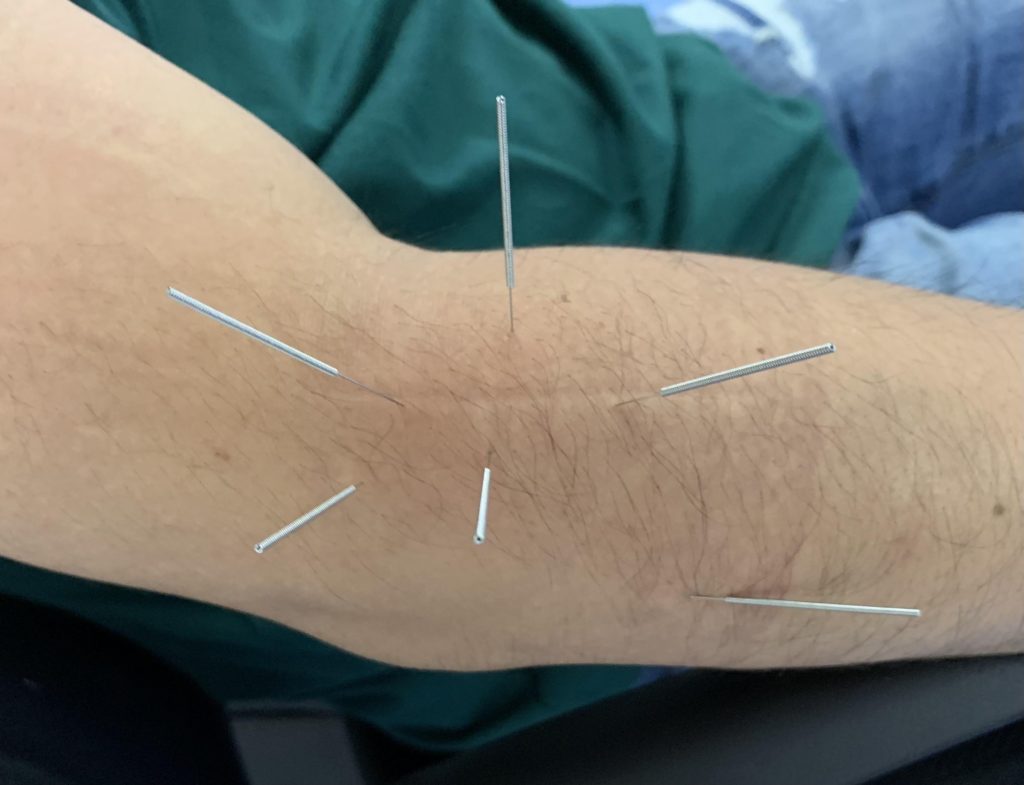
LI11 and LI10 are two of the most used local points for tennis elbow.
Local Tennis Elbow Acupuncture Points
Local tennis elbow acupuncture points sit on or near the sore tendon and the muscles that pull on it. In practice, each one targets a slightly different part of the problem.
- LI11 (Quchi) — at the outer end of the elbow crease when the arm is bent. It is the classic point for elbow pain and stiffness.
- LI10 (Shousanli) — about two thumb-widths below LI11 on the forearm. It sits in the wrist extensor muscles that often feel tight and tender.
- LI12 (Zhouliao) — just above and outside LI11, on the bone above the elbow. It is used when pain sits high on the epicondyle.
- LU5 (Chize) — on the elbow crease, beside the biceps tendon. It is used for elbow pain that limits straightening the arm.
- Ashi points — the tender spots found by pressing around the epicondyle. Needles are often placed in a ring around the sorest area.
Distal Acupuncture Points for Tennis Elbow
Distal tennis elbow acupuncture points work from a distance. They are especially useful when the elbow is too sore to needle heavily.
- SJ5 (Waiguan) — on the back of the forearm, above the wrist. It sits on the San Jiao channel that runs past the outer elbow.
- LI4 (Hegu) — in the web between the thumb and index finger. It is a major pain point for the arm. It is not used during pregnancy.
- GB34 (Yanglingquan) — below the outer knee. Classically, it is the influential point for tendons and sinews.
- SI11 (Tianzong) — on the shoulder blade. A small trial in Shanghai found that adding SI11 to local elbow points gave better results than local points alone.
Dry Needling, Electroacupuncture, and Laser
Acupuncture is rarely used alone for tennis elbow. Dry needling targets trigger points in the wrist extensors, the supinator, and the brachioradialis. These knots often keep the tendon under constant strain. Next, electroacupuncture adds a gentle current between paired needles. It is often used for stubborn tendon pain.
Finally, laser therapy is understood to support tissue repair and reduce pain through light energy. At the clinic, K-Laser treatment may be combined with needling for tendon injuries. Cupping and infrared heat may also be added to relax the forearm.
Acupressure Points for Tennis Elbow
Many people search for pressure points they can use at home. Acupressure uses the same tennis elbow acupuncture points, pressed by hand instead of needled. It is gentler and may offer relief between visits.
Try these steps once or twice a day:
- Press LI11 with your thumb for one to two minutes, using firm but comfortable pressure.
- Move down to LI10 and hold it the same way.
- Press LI4 on the same hand. Skip this point during pregnancy.
Avoid pressing hard on the sorest spot right over the tendon. Instead, work the muscles around it. Stop if pain sharpens or spreads.
When to See a Doctor First
Most tennis elbow is an overuse problem. Still, some signs warrant a medical evaluation. Seek prompt care after a fall or direct injury, or if the elbow is swollen, hot, or red. Numbness or tingling in the hand also needs a doctor’s review. So does an elbow that cannot fully straighten or bend.
Acupuncture for Tennis Elbow in Delray Beach
Dr. Tony Willcox, A.P., brings more than 20 years of clinical experience to sports and overuse injuries. He served as the Florida Panthers’ Official Acupuncturist for eight years and worked with the Blackzilians fight team for five. At Acupuncture Zen, he selects acupuncture points for tennis elbow to match each patient’s pain pattern and activity. Every first visit includes a focused evaluation plus acupuncture. Cupping, infrared heat, and electroacupuncture are included at no extra charge.
Learn more on the tennis elbow page, or explore other sports injuries we treat. Golfers can also view our treatment guide for golf or tennis elbow.
Ready to get back to your game? Call Acupuncture Zen at 561-633-3537 to schedule a visit in Delray Beach.
