


Sciatica is one of the most common reasons patients walk into Acupuncture Zen in Delray Beach. The pain is hard to ignore. It runs from the lower back through the buttock and down the leg—often with tingling or numbness. The research on acupuncture for sciatica is also among the strongest in the field.
Dr. Tony Willcox, A.P., approaches sciatica with more than one tool. Acupuncture addresses the irritated nerve pathway. Dry needling targets the tight muscles, and cupping lifts the restricted fascia. K-Laser therapy then supports the deep tissue. Here is what the research says about each — including where the evidence is still catching up.
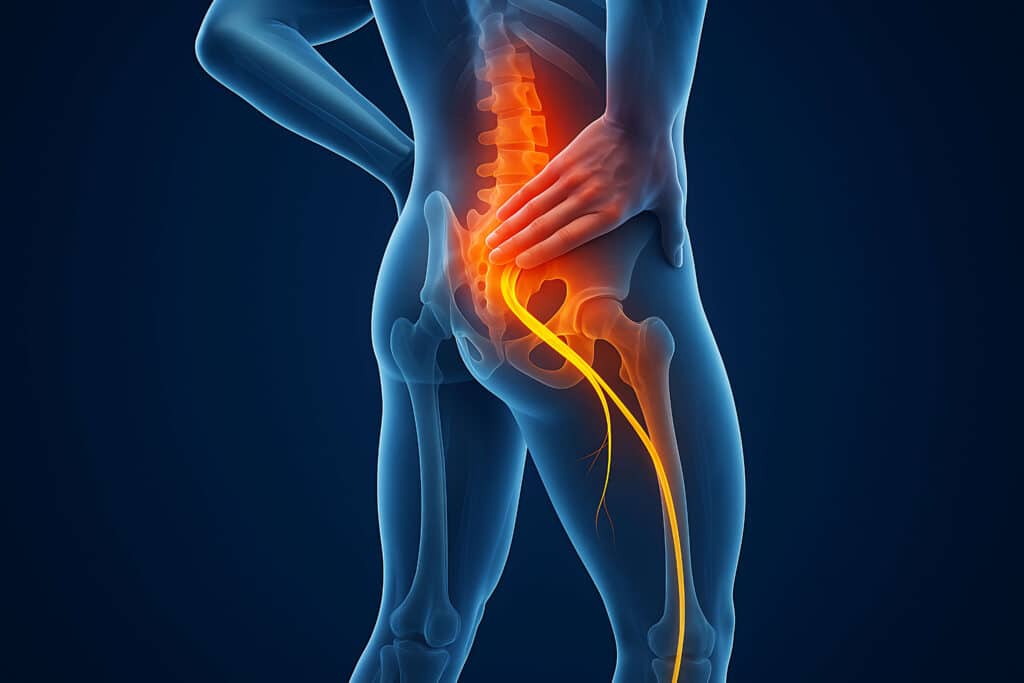
What Sciatica Is — and Why It Lingers
Sciatica is not a diagnosis in itself. It describes pain that travels along the sciatic nerve, which runs from the lower back down each leg. Most often, a herniated disk causes it. Lumbar spinal stenosis and a tight piriformis muscle deep in the buttock are other common causes.
Many cases settle within a week, but others don’t. Once sciatica passes the three-month mark, patients often face a choice between medication, injections, and waiting.
What the Research Shows on Acupuncture for Sciatica
The strongest evidence comes from a randomized clinical trial published in JAMA Internal Medicine in 2024. Researchers enrolled 216 adults with chronic sciatica from a herniated disk. Half received ten sessions of real acupuncture over four weeks. The other half received sham acupuncture — a convincing imitation designed to test whether the needling itself matters.
It did. At four weeks, leg pain in the acupuncture group had fallen by 30.8 points on a 100-point scale. In the sham group, it fell by 14.9 points. Disability scores improved by 13.0 points versus 4.9, and the benefit held — the difference between groups persisted through week 52, a full year after the study began.
The authors concluded that acupuncture “should be considered as a potential treatment option” for chronic sciatica from a herniated disk. Sham-controlled results with a one-year follow-up are rare in this field — especially in a major medical journal.
A broader view supports this. For example, a 2023 systematic review and meta-analysis in Frontiers in Neuroscience pooled 30 randomized trials involving 2,662 participants. Across those trials, acupuncture reduced sciatic pain more than medication or sham treatment. It also came with fewer reported adverse events than medication.
Two honest limits apply to the research on acupuncture for sciatica. First, the JAMA trial studied disk-related sciatica specifically. Its results therefore do not automatically extend to every cause of leg pain. Second, acupuncture does not repair a herniated disk. The research points to less pain and better function, not a structural fix.
Where Dry Needling Fits
Not all sciatic pain starts in the spine. Tight bands in the gluteal and piriformis muscles can irritate the nerve where it passes through the buttock. They also tend to tighten further in response to disk-related pain. Dry needling targets those trigger points directly.
The research here is smaller, and it is worth saying so. In a randomized trial published in Muscle & Nerve, 32 patients with piriformis syndrome took part. Half received three sessions of ultrasound-guided dry needling, and half received no treatment. One week later, pain in the needling group was decreased by about two points on a ten-point scale. The authors described that difference as clinically meaningful in the short term.
A second randomized trial of 58 people with disk-related radiating pain added dry needling to standard physical therapy. It reported greater improvement in the group that received needling. Both studies are modest in size and short in follow-up. Together, they suggest dry needling may help ease the muscular side of sciatica. It does not replace care for the nerve root itself.
Cupping and the Free Flow of Qi
One core tenet of Chinese medicine is that pain follows obstruction. The classical teaching puts it plainly — where there is free flow, there is no pain; where there is no free flow, there is pain. Sciatica is a textbook example. Traditionally, it reflects Qi and Blood stagnating in the Bladder and Gallbladder channels. Those channels run down the back and along the leg — the same path sciatic pain tends to take.
Cupping is one of the oldest methods for opening those channels. Dr. Tony uses traditional glass fire cups over the lower back, hips, and gluteal muscles. Sometimes he glides them along the tissue. The suction lifts and separates skin, fascia, and muscles. In modern terms, that may help release myofascial tightness around a painful nerve and support local circulation. In traditional terms, it restores the free flow of Qi.
The research on cupping is encouraging for back pain. However, it has not yet caught up to the research on acupuncture for sciatica. A systematic review and meta-analysis of cupping for chronic back pain drew on 16 studies and 1,049 participants. Overall, cupping reduced pain intensity by about 1.6 points on a ten-point scale. The authors called it promising but noted that protocols varied and the field needs higher-quality studies.
Closer to sciatica, a 2026 randomized trial in Frontiers in Medicine followed 60 patients with lumbar disk herniation. They received glass cupping over the lower back and gluteal region. After six sessions, average pain scores fell from 7.1 to 3.1 in the cupping group. In the control group, they fell from 7.0 to 4.1. It was a small, short-term study without a sham comparison — a useful signal, not a final answer.
K-Laser Therapy as a Supplement
Laser therapy is the newest of the four, and its role alongside acupuncture for sciatica is supportive. High-intensity laser therapy uses concentrated light to reach deep tissue. There, it may help support circulation and calm inflammation around an irritated nerve root.
A 2025 systematic review and meta-analysis pooled randomized trials of high-intensity laser therapy for spinal radiculopathy. That term covers nerve-root pain in the neck or lower back. Compared with placebo, laser reduced pain by 1.8 points on a ten-point scale and improved disability scores. Results were best when laser was combined with exercise or physical therapy. However, the authors rated the certainty of that evidence as low to very low. Better trials are still to come.
For deep spinal work, Acupuncture Zen uses the K-Laser Speciale 100 W. It is a Class IV laser with six wavelengths, including the 1064 nm wavelength used in much of the high-intensity laser research. The trials above used other high-intensity devices, generally at lower average power. Their results therefore describe the category, not this specific system. Dr. Tony uses it alongside needling, not in place of it.
A Layered Plan: Acupuncture for Sciatica in Delray Beach
Sciatica does not always start with a disk. It may also come from myofascial tightness or stiffness in the lower back, hip, and leg muscles. At your first visit, he will review the details—where the pain travels, what aggravates it, any weaknesses or numbness. Patients who have had an MRI should bring the written report rather than the disc. Dr. Tony relies on the radiologist’s findings, not his own reading of the images.
From there, Dr. Tony builds the plan in layers. Acupuncture — often with electroacupuncture for nerve-related pain — forms the base, because that is where the evidence is strongest. Dry needling comes in when the gluteal and piriformis muscles are part of the picture. Cupping follows when tension and stagnation bind up the lower back, and finally, K-Laser supports the deep tissue of the lower back. If spinal narrowing is behind the leg pain, read about acupuncture for lumbar spinal stenosis.
Acupuncture for sciatica is usually a course of care — the JAMA trial used ten sessions over four weeks. Nerve pain rarely responds to a single visit.
When Sciatica Needs a Doctor First
New or worsening leg weakness is a medical emergency. So is numbness in the groin or saddle area, or any change in bladder or bowel control. These symptoms need immediate evaluation — acupuncture is never a substitute for emergency care.
Is Acupuncture for Sciatica Right for You?
If sciatica has outlasted rest, stretching, and patience, the research gives good reason to consider acupuncture. It belongs alongside your physician’s care, not instead of it. Request an appointment with Dr. Tony Willcox at Acupuncture Zen in Delray Beach, or call 561-633-3537 to talk through your symptoms.
Dr. Tony Willcox, PhD, D.A.O.M., A.P., Dipl. Ac. & Dipl. C.H. (NCBAHM), Cert. DN (AAMT), is a licensed acupuncture physician with over 20 years of clinical experience. As founder of Acupuncture Zen in Delray Beach, Florida, he focuses on acupuncture, dry needling, cupping, K-Laser therapy, and NovoTHOR red light therapy.
This article is for educational purposes only. It is not a substitute for individualized medical advice, diagnosis, or treatment. Individual results vary. Acupuncture, dry needling, cupping, and laser therapy are used here as complementary approaches alongside conventional care.
Sources
- Tu et al., Acupuncture vs Sham Acupuncture for Chronic Sciatica From Herniated Disk, JAMA Internal Medicine 2024
- Zhang et al., The efficacy and safety of acupuncture therapy for sciatica, Frontiers in Neuroscience 2023
- Tabatabaiee et al., Ultrasound-guided dry needling decreases pain in patients with piriformis syndrome, Muscle & Nerve 2019
- Mahmoudzadeh et al., The effect of dry needling on the radiating pain in subjects with discogenic low-back pain, Journal of Research in Medical Sciences 2016
- de la Barra Ortiz et al., Effectiveness of high-intensity laser therapy in patients with spinal radiculopathy, 2025
- Moura et al., Cupping therapy and chronic back pain: systematic review and meta-analysis, Revista Latino-Americana de Enfermagem 2018
- Tian et al., Large-area cupping therapy for lumbar disc herniation of cold-damp type, Frontiers in Medicine 2026
- Sciatica condition page, acuzenme.com
- Laser Therapy service page, acuzenme.com
