Wrist Pain & Numbness Relief in Delray Beach
Medically reviewed by Dr. Tony Willcox, PhD, D.A.O.M., A.P.
Last reviewed: September 2026



Medically reviewed by Dr. Tony Willcox, PhD, D.A.O.M., A.P.
Last reviewed: September 2026
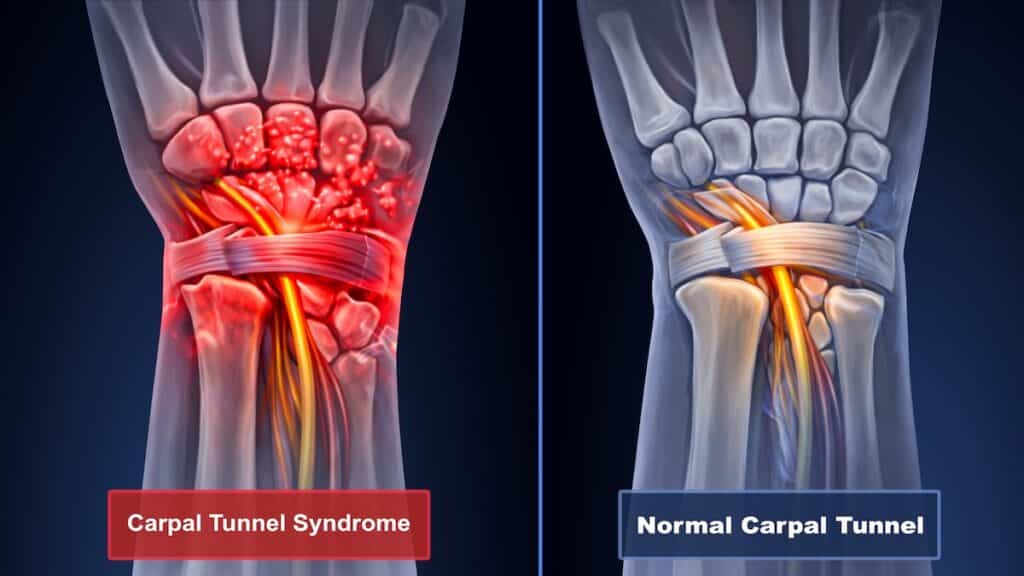
Carpal tunnel syndrome is the most common nerve entrapment condition, caused by compression of the median nerve as it passes through the narrow carpal tunnel at the wrist. When the tissues around the tunnel swell — from repetitive strain, inflammation, or fluid retention — they crowd the nerve, producing pain, numbness, and weakness in the hand. It commonly affects people who perform repetitive hand movements, and it is also linked to pregnancy, diabetes, and thyroid conditions. Symptoms typically build gradually and often start at night. Mild to moderate cases frequently respond to conservative care, while severe or long-standing cases sometimes require surgical release.
Carpal tunnel syndrome centers on the hand and wrist. Common symptoms include:
The core cause is pressure on the median nerve. Contributing factors include repetitive hand and wrist motion, awkward or sustained wrist positions, and underlying conditions such as pregnancy, diabetes, rheumatoid arthritis, and hypothyroidism, all of which can promote swelling around the nerve.
In Chinese medicine, carpal tunnel syndrome is understood as an obstruction of Qi and Blood in the channels that run through the wrist — a local blockage that deprives the area of nourishment and produces numbness, pain, and weakness. This obstruction may arise from repetitive strain, from cold and damp settling in the wrist, or from an underlying deficiency that leaves the channels poorly nourished. Treatment aims to restore free flow through the wrist, release the surrounding tension, and support the body’s overall circulation. Dr. Willcox tailors the approach based on whether the pattern is more one of acute obstruction or of underlying weakness.
Acupuncture for carpal tunnel is thought to work by improving circulation around the compressed nerve, reducing local inflammation and swelling, and calming the nervous system’s processing of pain and numbness. For this condition, electro-acupuncture — gentle electrical stimulation of the needles — is often used and has been a particular focus of research.
This is one of the more scientifically interesting applications of acupuncture. A 2023 systematic review and meta-analysis of sixteen randomized trials found that acupuncture, used as an adjunctive treatment, may benefit carpal tunnel syndrome across symptom severity, function, pain, and even nerve-conduction measures — though the authors rated the certainty of the evidence as low and called for more rigorous studies. Notably, neuroimaging research from Harvard-affiliated Massachusetts General Hospital has shown that acupuncture can produce measurable changes in median nerve function and in how the brain maps the hand, offering a glimpse into how the effect may work.
At Acupuncture Zen, carpal tunnel is often addressed with acupuncture and electro-acupuncture, sometimes with laser therapy, always as a complement to appropriate medical care.
A first visit begins with a conversation about the symptoms — which fingers are affected, whether they are worse at night, any repetitive activities or underlying conditions, and any diagnosis or nerve testing already done. Treatment involves fine needles placed at the wrist and forearm, and sometimes at more distant points, often with gentle electro-stimulation, followed by a period of rest. Because nerve-related change takes time, treatment is usually a series of sessions. Dr. Willcox coordinates with a patient’s physician, and will encourage prompt medical or surgical evaluation for severe cases involving constant numbness or muscle wasting.