


Tongue diagnosis surprises many first-time patients. Partway through the intake, the acupuncturist asks you to stick out your tongue. It can feel odd, yet it is one of the oldest assessment tools in Chinese medicine.
At Acupuncture Zen in Delray Beach, Dr. Tony Willcox, A.P., checks the tongue at nearly every visit. He trained in this method at Anhui University of Chinese Medicine in China. This guide explains why acupuncturists look at your tongue, what they notice, and how it shapes your treatment.
Why Do Acupuncturists Look at Your Tongue?
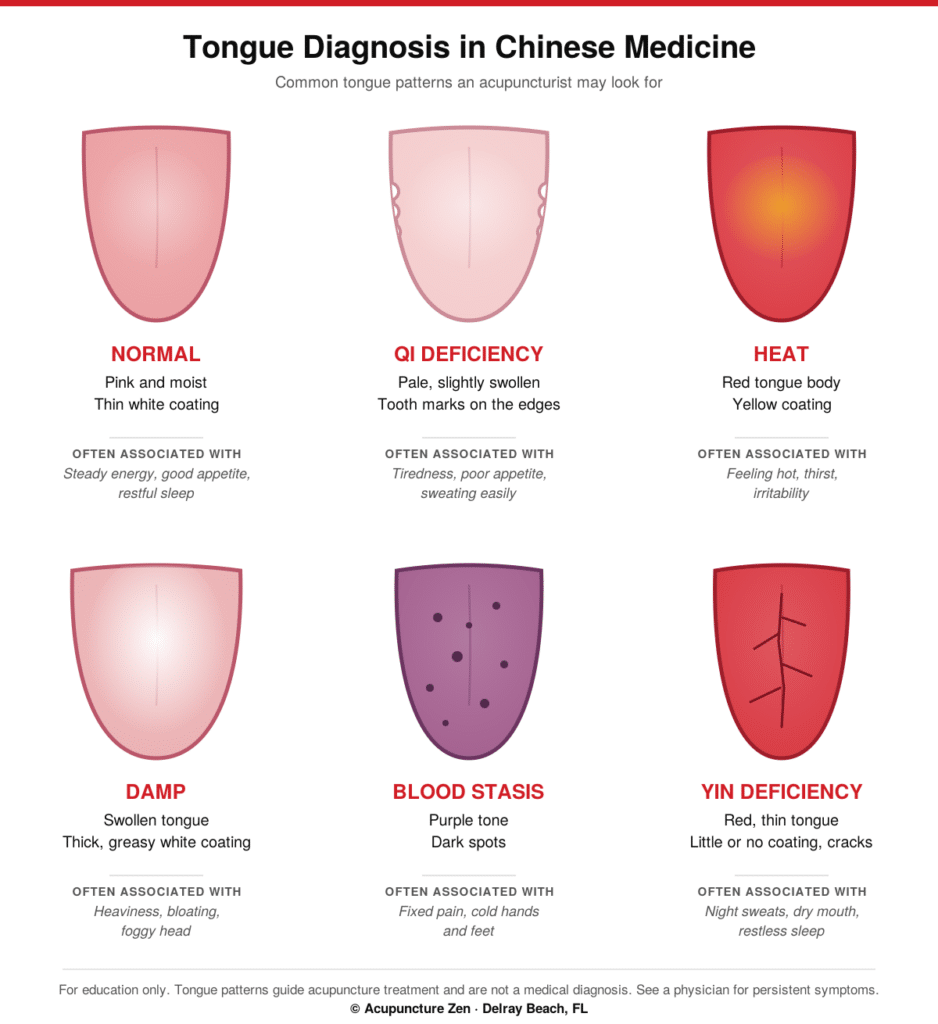
Common tongue patterns in Chinese medicine and the signs traditionally associated with each.
In Chinese medicine, the tongue offers a quick, visible snapshot of what is happening inside the body. Practitioners see it as a reflection of digestion, circulation, fluids, and overall balance.
Unlike a single symptom, the tongue changes slowly over days and weeks. As a result, it helps the practitioner track how your body responds to treatment. Together with the pulse and your answers to questions, it guides which acupuncture points to choose.
What Tongue Diagnosis Looks At
A practitioner usually checks five features. Each one adds a piece of the picture.
Color of the Tongue Body
A healthy tongue is typically a soft pink. A pale tongue is traditionally linked with deficiency or cold patterns. By contrast, a deep red tongue often points to heat. A purplish tone is associated with stagnation, meaning poor flow.
Shape and Size
Practitioners also notice whether the tongue looks swollen, thin, or average. For example, a puffy tongue with tooth marks along the edges often indicates weak digestion and fluid buildup. A thin tongue may suggest depletion.
Coating
Most tongues have a thin white coating. A thick coating can suggest sluggish digestion. Meanwhile, a yellow coating traditionally points to heat, and a missing coating may suggest dryness.
Moisture
The tongue should look slightly moist. A very wet tongue may indicate fluid buildup, while a dry tongue may indicate depleted fluids.
Cracks and Movement
Finally, practitioners look for cracks, a tremble, or a tongue that leans to one side. A deep central crack, for instance, is often linked with digestive patterns.
Common Tongue Diagnosis Patterns
In Chinese medicine, each tongue pattern is traditionally associated with certain signs. These are not a diagnosis. Instead, they help an acupuncturist understand your overall pattern. Any persistent symptom also deserves a medical check.
Qi Deficiency
A pale, slightly swollen tongue with tooth marks is often linked with:
- Tiredness, especially after effort
- Poor appetite or loose stools
- Shortness of breath on exertion
- Sweating easily
Heat
By contrast, a red tongue with a yellow coating is often linked with:
- Feeling hot or thirsty
- Irritability or restlessness
- Constipation
- A red face or flushed skin
Damp
A swollen tongue with a thick, greasy white coating is often linked with:
- Feeling heavy or sluggish
- Bloating or fullness after meals
- A foggy head
- Loose or sticky stools
Blood Stasis
Meanwhile, a purplish tongue with dark spots is often linked with:
- Fixed, stabbing pain in one spot
- Cold hands or feet
- Dark circles or visible veins
- Painful periods with clots
Yin Deficiency
Finally, a red, thin tongue with little coating and cracks is often linked with:
- Feeling warm in the evening
- Night sweats
- A dry mouth, throat, or skin
- Restless sleep
In practice, most people show a mix of patterns rather than just one. For that reason, the tongue is always read together with the pulse and your answers to questions.
The Tongue Map
Chinese medicine also divides the tongue into zones. The tip relates to the heart and lungs. The sides relate to the liver and gallbladder. Next, the center relates to digestion, and the back relates to the kidneys and lower body.
So, redness only at the tip might suggest restlessness or poor sleep. Similarly, a thick coating at the back may point to the lower body.
How to Prepare for Tongue Diagnosis
A few everyday things can change how your tongue looks. To give the clearest picture, try to:
- Avoid brushing or scraping your tongue right before your visit
- Skip coffee, colored drinks, and candy for an hour beforehand
- Avoid foods that stain, such as berries or turmeric
Mention any medications too, since some can affect the coating.
What Tongue Diagnosis Can and Cannot Do
Tongue diagnosis is a traditional assessment within Chinese medicine. For background on the terms, see what zhen jiu really means. It helps an acupuncturist choose a treatment approach. However, it does not diagnose disease the way a physician’s exam or lab test does.
Researchers have begun studying tongue features with digital imaging, and that work is ongoing. Even so, any new or worrying change deserves a medical check. For example, see a doctor for a sore that lasts more than two weeks. The same goes for a lasting white or red patch, or a lump.
Tongue Diagnosis at Acupuncture Zen
At your first visit, Dr. Willcox asks about your health, sleep, digestion, and stress. Then he checks your pulse and looks at your tongue. Together, these details shape where he places the needles.
At later visits, he checks the tongue again. Over time, the changes help show how your body is responding.
Frequently Asked Questions
Why did my acupuncturist look at my tongue?
Your acupuncturist used tongue diagnosis to understand your overall pattern. The color, coating, and shape help guide which points to use. It is a routine part of a Chinese medicine assessment.
What does a healthy tongue look like in Chinese medicine?
A healthy tongue is usually pink, slightly moist, and medium in size, with a thin white coating. It also sits straight and steady.
Can tongue diagnosis detect illness?
No. Tongue diagnosis guides acupuncture treatment, but it does not replace a medical exam. See a physician for any persistent change in your mouth.
Curious what your tongue might reveal? Call Acupuncture Zen at 561-633-3537 to schedule a visit in Delray Beach.
Peace and Blessings,
Dr. Tony Willcox, PhD, D.A.O.M., A.P.
