


What Is Trigeminal Neuralgia?
The trigeminal nerve is a paired cranial nerve with three branches. The ophthalmic branch (V1) serves the forehead and eye. Next, the maxillary branch (V2) covers the cheek, upper lip, and upper teeth. Finally, the mandibular branch (V3) supplies the jaw, the lower teeth, and the chewing muscles.
In most cases, a blood vessel presses on the nerve near the brainstem. As a result, the nerve fires pain signals far out of proportion to normal sensation. The condition is more common after age 50, and it affects women more often than men. Medication — usually an anticonvulsant such as carbamazepine — remains the first-line treatment. However, many patients look for complementary care when side effects build or relief fades.
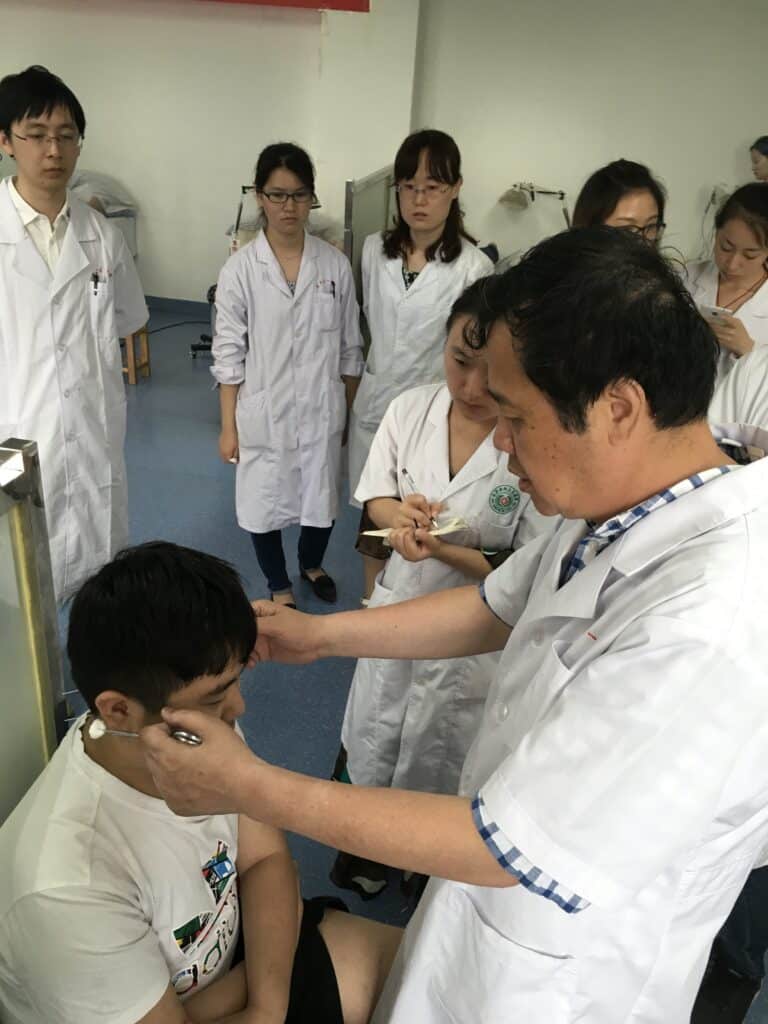
Professor Yang Jun demonstrates facial needling near ST7 for students during clinical training in China.
How Acupuncture May Help Trigeminal Neuralgia
In Chinese medicine, facial pain reflects blocked flow in the channels that cross the face. The Stomach (Yangming) and Gall Bladder (Shaoyang) channels are the main ones. Practitioners also identify an underlying pattern — such as Wind-Cold, Stomach Fire, Liver Yang rising, or Blood stasis. That pattern then guides which acupuncture points are chosen for trigeminal neuralgia.
From a modern view, acupuncture is understood to influence how the nervous system processes pain. It may calm overactive nerve firing and prompt the release of the body’s own pain-modulating chemicals. For nerve pain, electroacupuncture is often added. This technique passes a gentle current between paired needles.
Research on acupuncture for this condition continues to grow. For example, a 2026 systematic review and meta-analysis in the Journal of Pain Research pooled randomized trials. It found that acupuncture combined with medication was linked to higher response rates, lower pain scores, and fewer adverse events than medication alone. Even so, larger and well-designed trials are still needed to confirm these findings. For that reason, acupuncture is best viewed as complementary care — not a replacement for a neurologist’s plan.
Local Trigeminal Neuralgia Acupuncture Points
Local trigeminal neuralgia acupuncture points sit where the nerve’s branches emerge near the surface of the face. Each one matches the branch that carries the pain.
- ST7 (Xiaguan) — in the hollow in front of the jaw joint, just below the cheekbone. It is the meeting point of the Stomach and Gall Bladder channels. Classically, it treats jaw, tooth, cheek, and ear pain. For trigeminal neuralgia, it is often needled about 0.5 cun forward of its classical location. Some clinicians in China needle it deeply toward the sphenopalatine ganglion.
- ST2 (Sibai) — over the infraorbital foramen, where a maxillary (V2) nerve branch exits. It is used for cheek and upper-lip pain.
- BL2 (Zanzhu) — at the inner end of the eyebrow, near the supraorbital notch. It targets forehead and eye pain along the ophthalmic (V1) branch.
- Jiachengjiang (M-HN-18) — an extra point near the mental foramen on the chin. It serves the mandibular (V3) branch.
- ST6 (Jiache) — on the chewing muscle at the angle of the jaw. It is used for lower-jaw and tooth pain.
Distal Acupuncture Points for Trigeminal Neuralgia
Distal trigeminal neuralgia acupuncture points matter just as much. They allow treatment without touching the face’s most sensitive areas.
- LI4 (Hegu) — in the web between the thumb and index finger. It is the classic command point for the face and mouth. It is not used during pregnancy.
- LV3 (Taichong) — on the top of the foot, between the first and second toes. Paired with LI4, it forms the “Four Gates,” a combination used to calm pain and settle Liver Yang.
- ST44 (Neiting) — near the web of the second and third toes. It is often chosen when the pattern involves Stomach Fire.
During an active flare, practitioners often begin with distal points alone. Then, as the face tolerates touch, local points are added gently — sometimes on the unaffected side first.
Acupressure Points for Trigeminal Neuralgia
Many people search for pressure points they can use at home. Acupressure uses the same trigeminal neuralgia acupuncture points, but you press them by hand instead of needling. It is gentler, and it may offer some comfort between visits.
However, this condition calls for one important caution. Pressing a trigger zone on the face can set off an attack. For that reason, home acupressure works best on the hands and feet:
- Press LI4 with steady, comfortable pressure for one to two minutes on each hand. Skip this point during pregnancy.
- Press LV3 on each foot the same way.
- Breathe slowly while holding each point.
If light facial contact does not trigger pain, gentle holding at ST7 may also feel soothing. Stop at once if it sparks a twinge.
When to See a Doctor First
New facial pain always deserves a medical evaluation. A physician will usually order an MRI to rule out other causes. Also, seek prompt care for facial numbness, muscle weakness, vision changes, pain on both sides, or symptoms that begin before age 40. These signs can point to a different underlying condition.
Acupuncture for Facial Nerve Pain in Delray Beach
At Acupuncture Zen, Dr. Tony Willcox, PhD, D.A.O.M., A.P., selects trigeminal neuralgia acupuncture points to match each patient’s pattern and pain map. Every first visit includes a focused evaluation and acupuncture, with electroacupuncture included at no extra charge. Treatment is designed to complement — never replace — care from a neurologist or primary physician. Learn more on the trigeminal neuralgia condition page, or explore other neurological conditions the clinic treats.
Ready to ease facial nerve pain? Call Acupuncture Zen at 561-633-3537 to schedule a visit in Delray Beach.
Peace and Blessings,
Dr. Tony Willcox, PhD, D.A.O.M., A.P.
